

From Taxonomic Profile to Functional Potential of the Infant Microbiome
An integrated approach to analyzing the gut microbiome in the earliest stages of life.
Novabiomica was founded to transform the complexity of infant gut microbiome data into structured, interpretable information.
The analysis goes beyond characterizing microbial composition alone: it also incorporates the observation of potential functional capabilities associated with the microbiome, with the goal of offering a deeper understanding of each baby's unique gut ecosystem.
A Dynamic Ecosystem During a Critical Biological Window
During the first years of life, the infant gut microbiome undergoes a phase of rapid maturation. Mode of birth, feeding, antibiotic exposure, environment, and the progressive diversification of diet all contribute to shaping the gut microbial communities.
Taxonomic description alone, however, does not fully capture the biological complexity of the ecosystem.
Microorganisms belonging to the same species can show significant genomic differences and, as a result, a different repertoire of potential biological functions.
It is this distinction between taxonomic identity and functional potential that forms the foundation of Novabiomica's approach.

Mode of Birth

Feeding

Antibiotic Exposure

Environment

Progressive Diversification of Diet
Not Just Who Is Present, But What Biological Potential the Ecosystem Expresses
Microbiome characterization is organized into different levels of analysis.
Taxonomic Profile
Identification of the microorganisms detected and description of their relative abundance.
Genomic Characterization
Analysis of microbial genetic information to explore the biological diversity present within the ecosystem.
Functional Potential
Identification of genes and pathways associated with potential biological functions of the microbiome.
Contextualization
Organization of results in light of available scientific evidence and relevant contextual information.
Why Species Alone Doesn't Tell the Whole Story
The presence of a given microorganism does not necessarily mean that the same functional capabilities are present in every strain belonging to that species.
A particularly relevant example in the infant microbiome involves the relationship between breast milk, Human Milk Oligosaccharides (HMOs), and gut microorganisms.
HMOs largely reach the colon undigested by the infant and can be used by specific microorganisms that possess the necessary genetic repertoire.

HMOs

Microbial Genes and Pathways

Utilization

Metabolites
Functional characterization therefore makes it possible to examine the microbiome not only in terms of microbial presence and abundance, but also in terms of the potential genetic capabilities associated with specific biological functions.
From a Single Sample to the Microbiome's Trajectory
A single analysis represents a snapshot of the gut ecosystem at one specific point in time.
The availability of samples collected longitudinally, on the other hand, makes it possible to track changes over time in both the taxonomic composition and the functional potential of the microbiome.
This approach can be especially informative during biologically significant phases or events, such as:

Breastfeeding and Dietary Transition

Weaning
Antibiotic Exposure

Growth and Maturation of the Gut Ecosystem
Complex Data Organized for Clear Interpretation
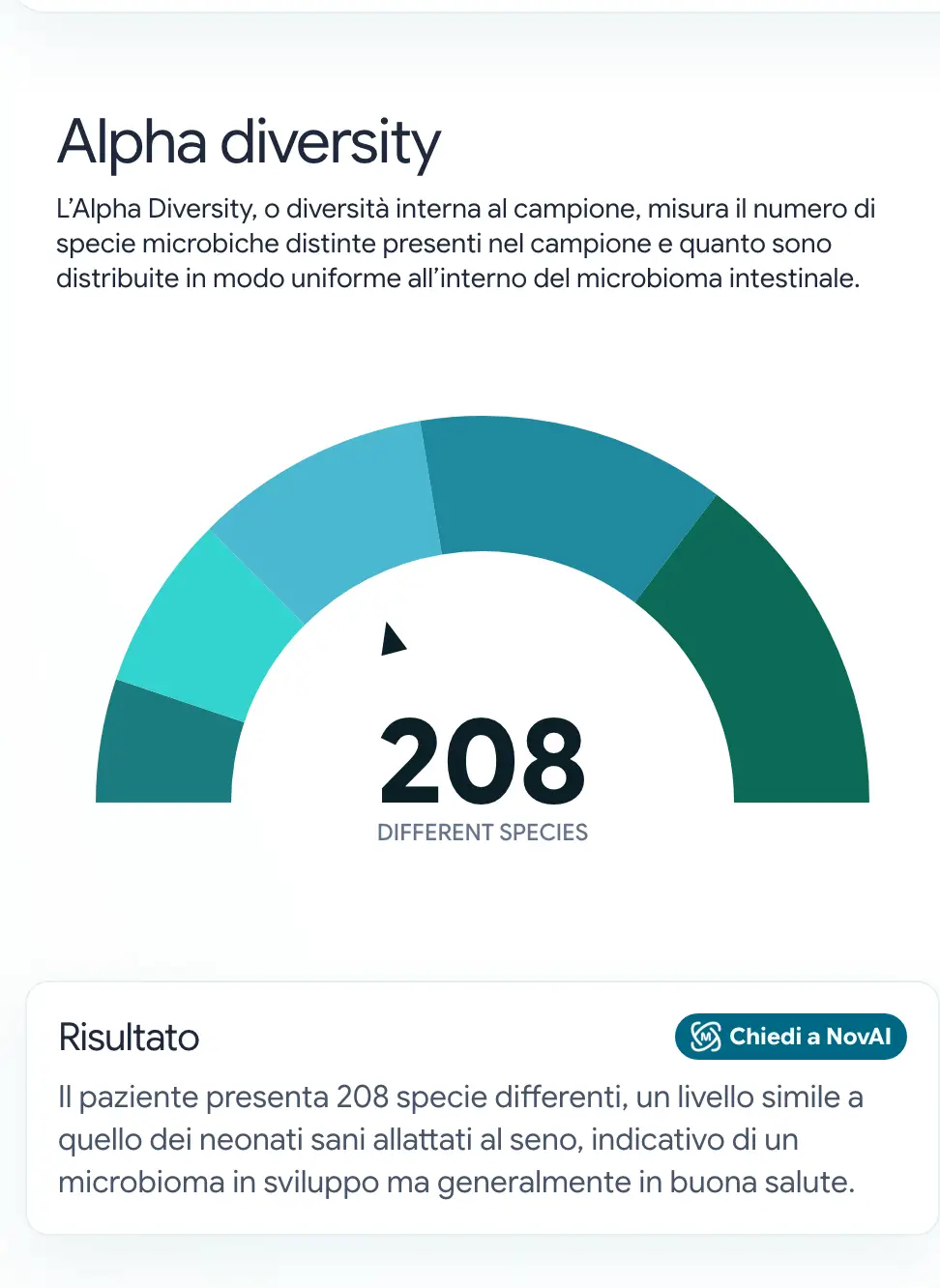
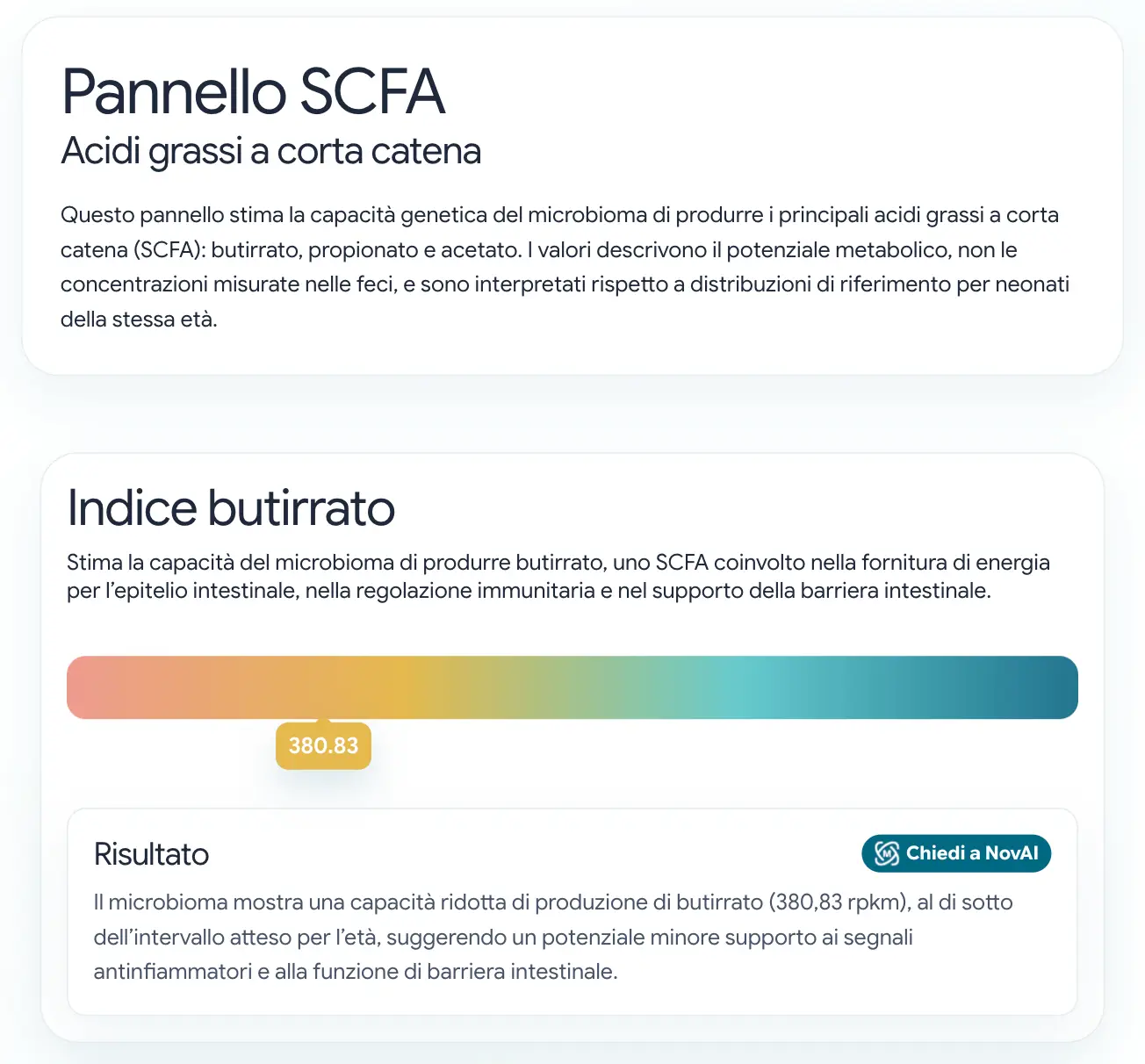
Analysis results are processed and presented through a dashboard designed to organize the different informational levels of the microbiome.

Taxonomic Composition
Profile of the microorganisms detected and their respective abundances.

Functional Potential
Information on the genetic capabilities potentially associated with the microbiome analyzed.

Scientific Contextualization
Interpretive insights based on available evidence.

Longitudinal Evolution
When multiple analyses are available, comparison of key parameters over time.
Microbiome Data Gains Meaning Within Context
The microbiome is characterized by high variability between individuals and a strong dependence on biological context.
Age, diet, mode of birth, medication exposure, medical history, and other factors can all contribute to the observed configuration.
For this reason, Novabiomica does not interpret the microbiome through an oversimplified lens of “good bacteria” versus “bad bacteria.”
The data is presented as biological information to be interpreted in context, avoiding the transformation of scientific associations into clinical conclusions.
A Platform Built Around Research
Novabiomica's scientific development is supported by expertise in the microbiome, bioinformatics, and life sciences, with dedicated scientific governance overseeing the evaluation of evidence, methodological development, and data interpretation.
Giorgio Casaburi
Chief Scientific Officer · NovabiomicaInternational researcher specializing in the microbiome, bioinformatics, and functional analysis of biological data. He coordinates the scientific direction of the project, methodological development, and the integration of microbiome analysis technologies within the Novabiomica platform.
The Novabiomica Team →Steven A. Frese, Ph.D.
Scientific Advisory Board · Associate Professor, University of NevadaAssociate Professor at the University of Nevada and a microbiologist with extensive experience in the gut microbiome, with particular expertise in host–microbe interactions, microbial ecology, and the role of nutrition in shaping the microbiome during the earliest stages of life.
The Scientific Advisory Board →From literature to the platform
Research on the infant gut microbiome underlies Novabiomica's approach.
Our indicators are based on international scientific literature, including publications co-authored by Giorgio Casaburi and Steven A. Frese. On the dedicated page, you'll find the most relevant studies, the extended bibliography, a description of the ten indicators, and the analytical methodology, along with the interpretive limitations of the analyses.
View the Scientific Evidence →Scientific Rigor Also Means Defining What the Data Cannot Tell Us
Novabiomica provides information on the composition and potential functional characteristics of the gut microbiome.
The informational report is not a diagnosis or a treatment recommendation.
The associations described in the scientific literature do not necessarily imply causal relationships and should be interpreted in light of the individual context and the current state of available evidence.
The informational report does not replace the evaluation of a pediatrician or other qualified healthcare professional.
For Pediatricians, Researchers, and Healthcare Professionals
Novabiomica welcomes dialogue with professionals interested in infant microbiome analysis, methodology, interpretation of results, and the development of research projects and longitudinal studies.
If you are a pediatrician, healthcare professional, or researcher, you can get in touch directly with our scientific team.
Contact Our Scientific Team
