


Indice dei contenuti
Has your newborn not pooped for two or three days, and you’re wondering if you should worry? It’s one of the most common questions in the first months. There’s no single number of days that applies to every baby: what matters is their age, how they’re fed, whether they’re growing and wetting diapers, and what their poop looks like when it does come.
In this article, we’ll look at what studies say about bowel movement patterns in the first months, why many babies strain and cry even when their poop is soft, how to recognize constipation, and which signs mean it’s time to call the pediatrician.
How many days without pooping? Why age and diet matter
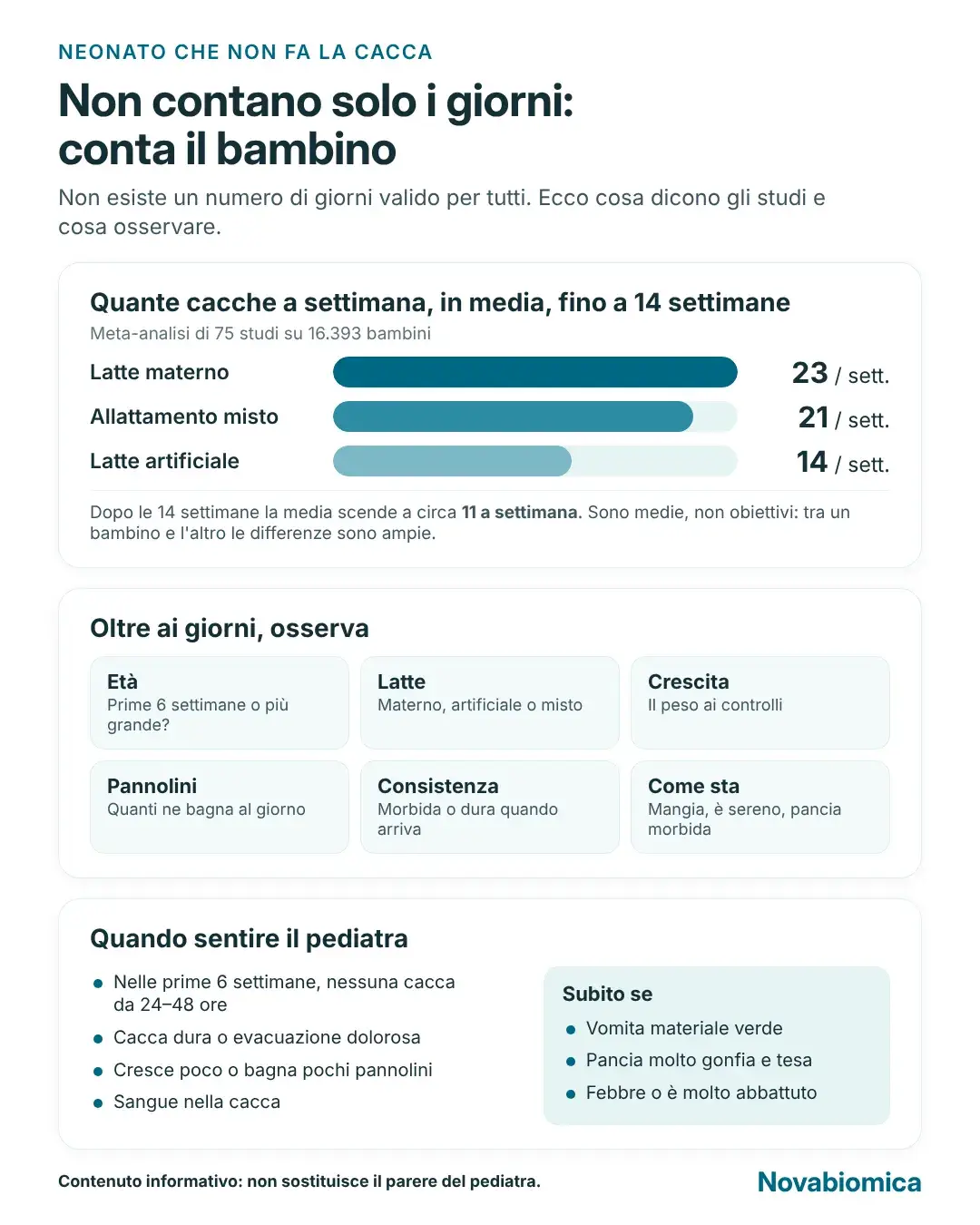
There’s no single day-count threshold that applies to every newborn. In the first six weeks, a breastfed baby usually poops at least twice a day; if 24–48 hours pass without a bowel movement, it’s a good idea to check with the midwife or pediatrician. After six weeks, gaps of a few days become more common. [2]
In the first few weeks, in fact, infrequent bowel movements can be a sign that the baby isn’t getting enough milk. [2] Later on, in breastfed babies, poop can become less frequent, sometimes by several days, while still staying soft when it comes. [2]
That’s why the number of days alone doesn’t tell you much. Along with the number of days, you should also look at:
- the baby’s age, in days, weeks, or months;
- how they’re fed: breast milk, formula, or a mix of both;
- their growth at pediatrician checkups;
- how many diapers they wet during the day;
- what their poop looks like when it comes: soft or hard;
- how they’re doing overall: whether they eat well, seem content between feedings, and have a soft belly.
Here’s the key point: it’s not just about how many days it’s been since the newborn last pooped, but also how many days or weeks old they are, how they’re fed, and how they’re doing overall. A two-month-old breastfed baby who’s growing well and has soft poop can go three or four days without a bowel movement. The same number of days in a two-week-old newborn, on the other hand, is worth a call to the pediatrician.
How often does a newborn poop?
In the first three months, babies poop, on average, about three times a day. A meta-analysis of 75 studies involving more than 16,000 children found an average of 21.8 bowel movements per week up to 14 weeks of age, dropping to about 11 per week in the following months. These are averages, not targets to aim for. [1]
The same analysis shows wide differences from one baby to another: some poop after nearly every feeding, while others go every two or three days. The pattern also changes over time, since the gut matures over the weeks and bowel movements tend to become less frequent. [1]
Beyond frequency, color and consistency also tell you a lot. You can find them explained in our guide on newborn poop: color and consistency and in our article on green poop in newborns.
Breast milk or formula: why the frequency changes
In the first 14 weeks, breastfed babies poop more often and more softly: on average about 23 times a week, compared to about 14 times for formula-fed babies and 21 for babies on a mix of both. [1] With formula, it’s common to see firmer stools and somewhat longer gaps between bowel movements.
These differences come from the composition of the two types of milk and how the baby’s gut digests them. They don’t mean one feeding method is “right” and the other isn’t—they simply help you read your own baby’s rhythm in context.
If your baby is on formula and their poop becomes hard or infrequent, don’t switch formulas or change the dilution on your own. Formula powder should always be prepared exactly as directed on the package, and any changes should be made together with the pediatrician.
Straining, turning red, and crying: is it always constipation?
No. Many babies strain, turn red, and cry before pooping, and then pass soft stool. In this case, it’s not constipation: the baby is learning to coordinate pushing with their belly while relaxing the muscles of the pelvic floor. This pattern is called infant dyschezia. [3]
The difference lies in the consistency of the poop. If it comes out soft after the straining, the issue isn’t with how things move through the gut but with coordination. Constipation, on the other hand, involves hard stools, painful bowel movements, and a tendency to hold them in. [4][5]
Infant dyschezia: a gut that’s learning to coordinate
Infant dyschezia is a phase in which, during the first months, the baby strains and cries for several minutes before passing soft stool. It affects about 2–4 babies out of 100 under six months of age, stems from coordination that’s still developing, and resolves on its own as the baby grows. [3]
To describe it, pediatricians use the Rome IV criteria, an internationally recognized reference. In short, they apply to an infant under nine months who strains and cries for at least ten minutes before passing soft stool, with no other health issues. [4] These criteria are meant for pediatricians, not a checklist for parents to use at home—if this description sounds familiar, mention it at your next checkup.
So what actually helps? Mostly, knowing that this is a learning phase. Pediatric guidelines recommend reassuring parents, avoiding rectal stimulation—since the baby needs to learn to do it on their own—and not using laxatives. [3]
The gut microbiome also changes a great deal in the first months, alongside diet. However, there’s no reason to attribute dyschezia, or the occasional day without pooping, to the composition of the microbiome: at this stage, what matters most is maturation and coordination.
How to recognize constipation in a newborn
Constipation isn’t the same as infrequent bowel movements. It’s considered constipation when the stool is hard, bowel movements are painful, or the baby tends to hold it in. For pediatricians, duration matters too: the reference criteria consider at least one month, but that’s not a waiting period for parents. [4][6]
In children under four years old, the Rome IV criteria require that at least two of five signs be present for at least one month. These signs relate to the frequency of bowel movements, hardness and pain, holding it in, and stool size. [4] Bambino Gesù Children’s Hospital, for example, lists two or fewer bowel movements per week among these signs. [6]
The one-month period is a criterion for pediatricians, not a waiting time for parents at home. If the poop is hard and the baby is in distress, you can bring it up right away. The 2014 European and North American guidelines (ESPGHAN and NASPGHAN), which use the previous version of the criteria, also list signs that call for a faster evaluation. [5]
How to help your newborn poop at home
If your baby is otherwise well, there are simple things you can try at home: a gentle clockwise belly massage, “bicycle” leg movements, a warm bath, and a bit of patience. Before trying any remedy, though, ask yourself whether it’s really constipation or dyschezia.
A few practical tips:
- Belly massage: using a warm hand, make slow clockwise circles around the belly button, when the baby is calm and not right after a feeding.
- Bicycle legs: with the baby on their back, gently bring their knees toward the belly, alternating sides.
- Holding position: holding the baby with their knees slightly bent toward the belly can give them a more comfortable position for pushing.
- In the first weeks: if bowel movements are infrequent, the first thing to check with the midwife or pediatrician is whether the baby is getting enough milk. [2]
What to avoid
- Rectal stimulation with a thermometer, cotton swab, or tube. [3]
- Laxatives, suppositories, and enemas without the pediatrician’s guidance. [3]
- Changing formula or its dilution on your own.
- Water, herbal teas, or juices as a one-size-fits-all remedy: these should be discussed with the pediatrician.
- Remedies found online to “unblock” the gut, without distinguishing between constipation and dyschezia.
When to ask the pediatrician for advice
Call the pediatrician if your newborn is only a few weeks old and poops rarely, if the poop is hard or the baby seems to be in pain, if growth is slow or diapers are rarely wet, or if you see blood in the stool. Some signs, like green vomit or a very swollen belly, call for urgent evaluation. [2][5]
Talk to the pediatrician soon if:
- in the first six weeks, the baby hasn’t pooped in 24–48 hours [2];
- difficulty pooping started in the first month of life [5];
- the meconium, the first dark stool, was passed more than 48 hours after birth [5];
- growth is slow or diapers are rarely wet [2][5];
- the poop is hard or pellet-like, or bowel movements are painful;
- you see blood in the poop. [5]
Seek help right away if:
- the baby vomits green material [5];
- the belly is very swollen and tight, especially if the baby seems to be in distress [5];
- the baby has a fever, seems very lethargic, or refuses milk. [5]
In every other case, if you’re unsure, talking to the pediatrician is always a good idea: they know your baby’s history and can look at the full picture.
Informational content: this does not replace the pediatrician’s advice.
Newborn poop in the first months: the free guide for parents
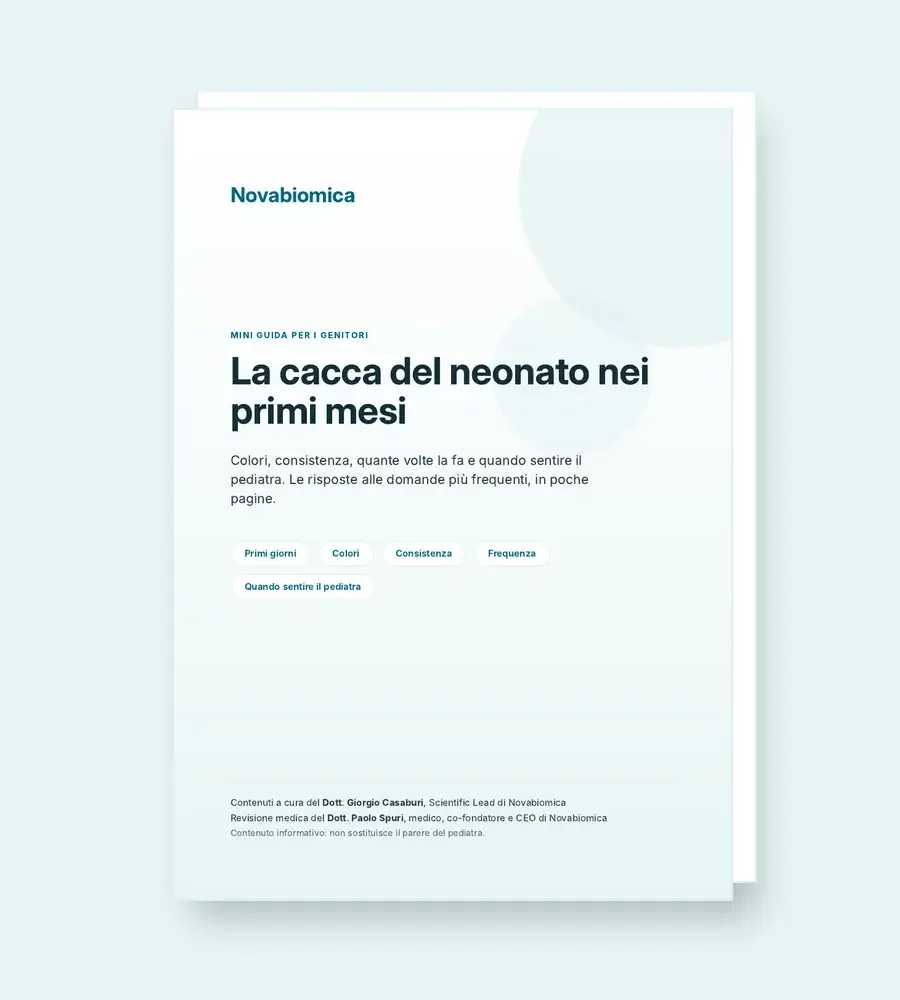
Colors, consistency, how often, and how many days can pass without pooping: there are so many questions in the first months of a newborn’s life. That’s why we’ve gathered the answers in a free mini PDF guide you can keep on your phone or print out. Inside, you’ll find a chart of newborn poop colors, the difference between dyschezia and constipation, what to do at home, and the signs that mean it’s time to call the pediatrician.
Content curated by Dr. Giorgio Casaburi, with medical review by Dr. Paolo Spuri.
Enter your email and get the guide sent straight to your inbox.
FAQ – Frequently asked questions about newborns not pooping
The baby passes gas but doesn’t poop: is that normal?
This happens often, especially in breastfed babies after the first few weeks. Passing gas shows that the gut is moving, but on its own, it doesn’t mean everything’s fine—also look at growth, wet diapers, poop consistency, and how the baby is doing overall.
Does the baby need water or herbal tea?
Not as a general remedy. In the first months, milk covers the baby’s fluid needs, and water or herbal tea can reduce the amount of milk they take in. If you think your baby needs something extra, ask the pediatrician.
How wet should diapers be?
After the first few days, a baby getting enough milk wets several diapers a day, heavy and with clear urine. If wet diapers decrease, or the urine is dark, call the pediatrician.
When does infant dyschezia go away?
It usually resolves on its own in the first months, as the baby learns to coordinate pushing. No stimulation or laxatives are needed. [3]
Does poop get harder with weaning?
Often, yes: with the first solid foods, poop changes in color, smell, and consistency, and can become firmer. If it becomes hard or the baby struggles, talk to the pediatrician before changing their diet.
Sources
- Baaleman DF, Wegh CAM, de Leeuw TJM, et al. What are Normal Defecation Patterns in Healthy Children up to Four Years of Age? A Systematic Review and Meta-Analysis. J Pediatr. 2023;261:113559. doi:10.1016/j.jpeds.2023.113559
- NHS. Constipation and breastfeeding. Best Start in Life, updated 01/28/2026. nhs.uk
- Zeevenhooven J, Koppen IJN, Benninga MA. The New Rome IV Criteria for Functional Gastrointestinal Disorders in Infants and Toddlers. Pediatr Gastroenterol Hepatol Nutr. 2017;20(1):1–13. PMCFrequently Asked Questions
The baby passes gas but doesn’t poop: is that normal? This happens often, especially in breastfed babies after the first few weeks. Passing gas shows that the gut is moving, but on its own, it doesn’t mean everything’s fine—also look at growth, wet diapers, poop consistency, and how the baby is doing overall.
Does the baby need water or herbal tea? Not as a general remedy. In the first months, milk covers the baby’s fluid needs, and water or herbal tea can reduce the amount of milk they take in. If you think your baby needs something extra, ask the pediatrician.
How wet should diapers be? After the first few days, a baby getting enough milk wets several diapers a day, heavy and with clear urine. If wet diapers decrease, or the urine is dark, call the pediatrician.
When does infant dyschezia go away? It usually resolves on its own in the first months, as the baby learns to coordinate pushing. No stimulation or laxatives are needed. [3]
Does poop get harder with weaning? Often, yes: with the first solid foods, poop changes in color, smell, and consistency, and can become firmer. If it becomes hard or the baby struggles, talk to the pediatrician before changing their diet.
5385301 - Benninga MA, Faure C, Hyman PE, et al. Childhood Functional Gastrointestinal Disorders: Neonate/Toddler. Gastroenterology. 2016;150(6):1443–1455. doi:10.1053/j.gastro.2016.02.016
- Tabbers MM, Di Lorenzo C, Berger MY, et al. Evaluation and treatment of functional constipation in infants and children: evidence-based recommendations from ESPGHAN and NASPGHAN. J Pediatr Gastroenterol Nutr. 2014;58(2):258–274. doi:10.1097/MPG.0000000000000266
- Bambino Gesù Children’s Hospital. Constipation. 09/28/2022. ospedalebambinogesu.it
Your baby’s microbiome, month by month.
In the first months of life, your baby’s gut is constantly changing. With Novabiomica, you’ll be able to discover your baby’s microbiome composition and track its evolution over time, with descriptive information curated by our scientific team. The kit isn’t available yet: join the waitlist to be among the first to know when it launches.

